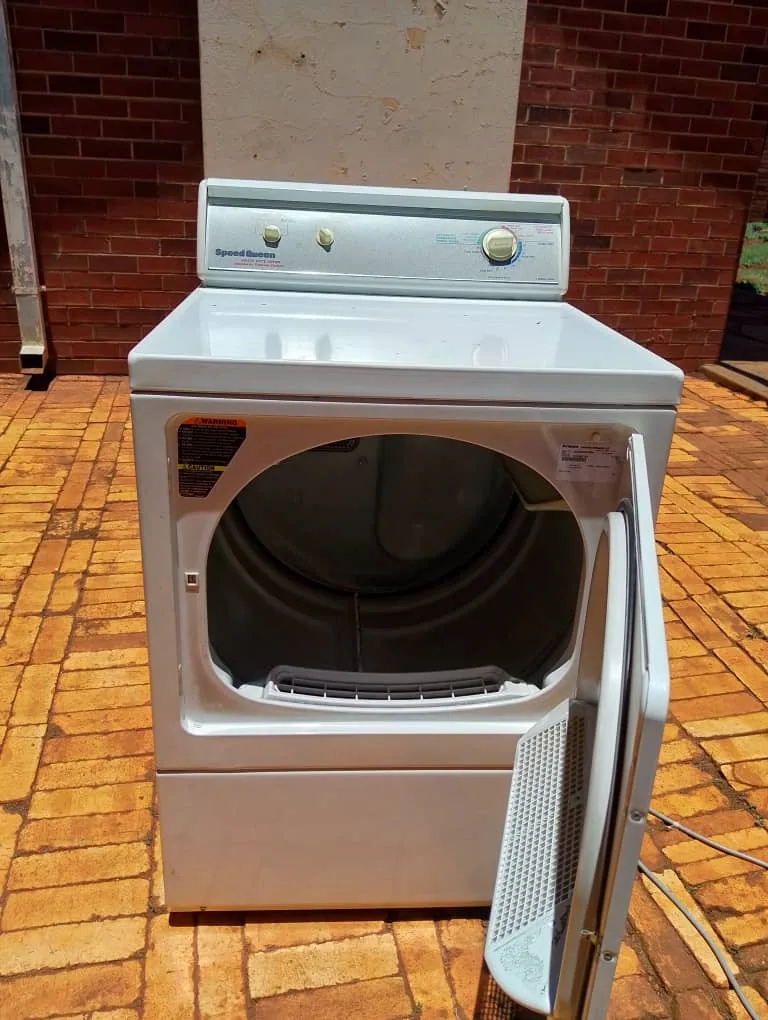
Tumble dryer not heating: If your tumble dryer is not heating but the drum still turns, the machine is telling you something specific has failed — it has not simply broken down. In most cases the cause is one of a small handful of faults: a blocked exhaust path, a blown thermal fuse, a failed heating element, or a simple power or settings issue. Working through these in order will help you identify the problem quickly and decide whether it is safe to continue using the machine or whether you need a technician.
How a tumble dryer produces heat
Most domestic tumble dryers use one of two heat sources: an electric heating element or a gas burner. Electric models — by far the most common in Harare households — pass current through a coiled resistance element. The element heats the air, a fan pushes that warm air through the drum, and the moist air exits through the exhaust duct. Several safety components sit alongside the element to prevent overheating, including thermostats and a thermal fuse. If any one of these components fails, the dryer can run normally in every other respect while producing no useful heat at all.
Check the lint filter and exhaust vent first
Before assuming an internal component has failed, check the two most accessible parts of the system.
Lint filter
The lint filter catches fibres shed by your laundry. A heavily clogged filter restricts airflow so severely that the dryer's safety thermostat cuts the heat to prevent a fire. Remove the filter — usually found inside the door opening — and hold it up to the light. If you cannot see through it, clean it thoroughly under running water, allow it to dry completely, and refit it before running the machine again.
Exhaust vent and ducting
Even with a clean filter, a kinked, crushed, or blocked exhaust hose will trap hot, moist air inside the drum. Check the full length of the duct from the back of the machine to where it exits the wall or window. Look for:
- Sharp bends or kinks that have collapsed the hose
- Lint build-up inside the duct itself
- A flap or grille on the outside that is stuck shut
Straighten or replace a kinked hose and clear any blockage at the exit point. Restricted airflow is one of the leading causes of a dryer that runs but will not heat, and it is also a fire risk, so this check is worth doing even if you suspect another fault.
Thermostat and thermal fuse faults explained
Electric tumble dryers contain at least two types of temperature-control component: cycling thermostats and a thermal fuse.
Cycling thermostats
These switch the heating element on and off to maintain the correct drum temperature. A faulty cycling thermostat can stick open, which means it never signals the element to switch on, leaving you with a cold drum. Thermostats can sometimes be tested with a multimeter for continuity, but accessing them requires removing the back or front panel of the machine.
Thermal fuse
The thermal fuse is a one-shot safety device. If the dryer overheats — usually because of a blocked vent or a faulty thermostat — the thermal fuse blows permanently to cut power to the heating circuit. Once a thermal fuse has blown, it cannot reset itself and must be replaced. A dryer with a blown thermal fuse will run the drum and the timer normally but will produce no heat whatsoever. Replacing the fuse without also finding and fixing the underlying cause of the overheating means the new fuse is likely to blow again quickly.
A blown thermal fuse is one of the most common reasons a tumble dryer runs but does not heat up. It is a safety device, not a maintenance item — if it has blown, something else caused the overheating.
Heating element failure: signs to look for
If the airflow is clear and the thermostats and fuse are intact, the heating element itself may have failed. Elements can burn out gradually or snap suddenly. Signs that point to element failure include:
- The drum turns and the fan runs, but there is absolutely no warmth at any point in the cycle
- A faint burning smell when the fault first appeared (though this may have passed)
- Visible breaks or scorch marks on the element coil if you can access it safely
A broken element coil will show no continuity on a multimeter. Element replacement is a straightforward repair for a qualified technician but involves disassembling a significant portion of the machine, so it is not a task to attempt without the right tools and experience.
Power supply and programme setting checks
A few simple checks can rule out non-mechanical causes before you go further.
- Check the programme selected. Some dryers have a cool-air or air-fluff setting that tumbles laundry without heat. Confirm the dial or display is set to a heated cycle.
- Check the power supply. Electric dryers typically draw a high current. If the circuit breaker has tripped or a fuse in the consumer unit has blown, the machine may receive enough power to run the motor but not the element. Reset any tripped breaker and test again.
- Check the door switch. A faulty door switch can prevent the heating circuit from completing even when the door appears fully closed. Try pressing the door firmly shut and starting a cycle.
Why overloading affects drying performance
Overloading is not a fault in the mechanical sense, but it reliably produces the symptom of clothes coming out damp or cold. When the drum is packed too tightly, warm air cannot circulate freely around the laundry. The result is that the thermostat may cut the heat early because the air temperature near the sensor rises quickly, even though the clothes themselves are still wet and cold. As a rule, the drum should be no more than half to two-thirds full to allow proper tumbling and airflow. If your dryer has always struggled with large loads, try splitting them and see whether performance improves before assuming a component has failed.
Faults that require a qualified technician
Some checks are safe to carry out yourself — cleaning the lint filter, inspecting the duct, checking the programme setting. Others involve live electrical components and should only be handled by someone with the right training and tools. Call a technician if:
- You have completed the basic checks and the dryer still does not heat
- You suspect a blown thermal fuse or failed thermostat
- The heating element needs testing or replacing
- The machine trips the circuit breaker when it tries to heat
- There is any smell of burning plastic or scorching from inside the cabinet
- The machine is still under any manufacturer warranty — opening it yourself may void that warranty
It is not safe to continue using a tumble dryer that is not heating if you also notice burning smells, tripped breakers, or scorch marks. Switch the machine off at the wall and leave it until it has been inspected. A dryer that simply produces no heat but shows none of those warning signs is generally safe to leave unplugged until a repair is arranged, but it should not be used in that condition as the underlying fault may worsen.
Next steps
If you have worked through the checks above and your tumble dryer is still not heating, the fault is most likely internal and needs a proper diagnosis. City Appliance Repairs carries out tumble dryer repairs across Harare. Contact the team to arrange an assessment — bring as much detail as you can about what the machine does and does not do, including any sounds, smells, or error codes, so the technician can come prepared.
For professional diagnosis and repair assistance in Harare, contact City Appliance Repairs.
Frequently asked questions
Why does my tumble dryer run but not heat up?
The most common causes are a blocked lint filter or exhaust vent triggering a safety cut-out, a blown thermal fuse, a failed heating element, or a faulty thermostat. Start by cleaning the lint filter and checking the exhaust duct, then work through the electrical components if airflow is not the issue.
Can a blocked lint filter stop a dryer from heating?
Yes. A heavily clogged lint filter restricts airflow enough to cause the dryer to overheat internally, which triggers the safety thermostat to cut the heat. Cleaning the filter regularly is one of the simplest ways to prevent this fault.
What is a thermal fuse and can it cause a dryer to stop heating?
A thermal fuse is a one-shot safety device that permanently cuts the heating circuit if the dryer overheats. Once blown it cannot reset, so the drum will continue to turn but no heat will be produced until the fuse is replaced and the underlying cause of the overheating is fixed.
Is it safe to use a tumble dryer that is not getting hot?
If the only symptom is a lack of heat with no burning smell, tripped breakers, or visible scorching, the machine is generally safe to leave unplugged until repaired. However, if any of those warning signs are present, switch the machine off at the wall immediately and do not use it until a technician has inspected it.
Can overloading a tumble dryer cause it to stop heating?
Overloading restricts airflow inside the drum, which can cause the safety thermostat to cut the heat prematurely even though the laundry is still wet. Try running a smaller load to see whether the problem persists before assuming a component has failed.